Agency economics are simple: revenue scales with client count, but headcount scales with management time. The agencies growing profitably in 2026 have solved that equation – not by working harder, but by changing how much time each client account actually requires to manage.
AI ad platforms, also known as ad platform AI systems, are the operational infrastructure behind that shift. This article covers how agencies are using them, which workflows are changing, and what 60%+ time savings actually looks like across a typical agency operation.
Where Agency Management Time Actually Goes
Before getting into where AI saves time, it’s worth being specific about where agency time goes in the first place.
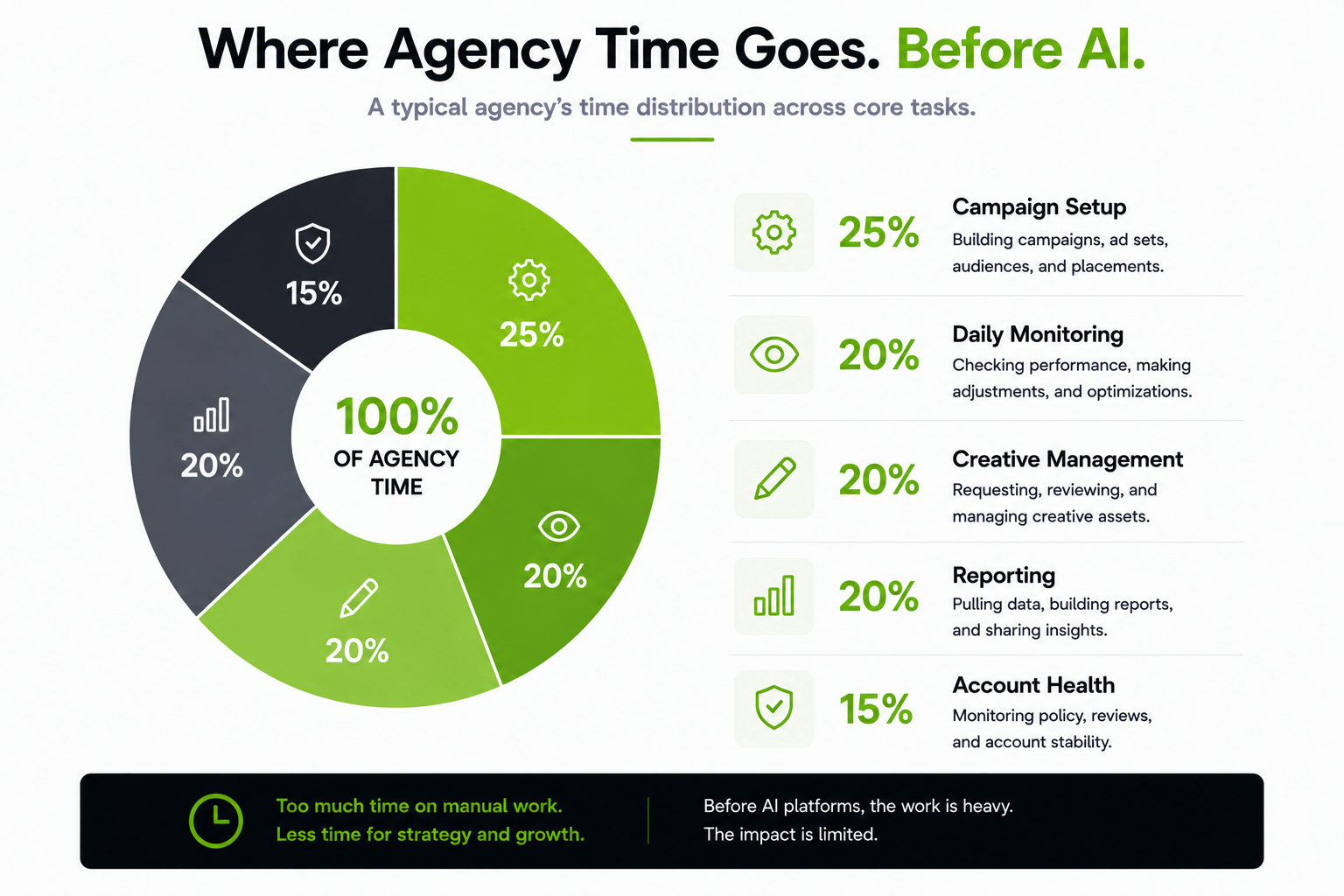
For a performance marketing agency managing 10-20 clients on Meta and TikTok, the time distribution typically looks like this:
Campaign setup and launch – building campaign structures, configuring audiences, uploading creative, setting budgets, checking placements. For a new campaign or a new client, this can run 4-8 hours. For a campaign refresh across multiple accounts, it compounds quickly.
Ongoing campaign monitoring – checking performance daily, identifying underperformers, pausing or adjusting ad sets, reacting to performance swings. For 15 accounts, this is a daily ritual that can consume 2-3 hours even for experienced buyers.
Creative production and management – briefing creatives, managing the production cycle, uploading new creative when fatigue sets in, organizing the asset library. The higher the account count, the more this bottlenecks growth.
Reporting – pulling data from multiple platform dashboards, compiling it into client-facing formats, writing analysis. Weekly reporting for 15 clients can run a full day.
Account health monitoring – catching issues before they become problems: policy flags, billing issues, audience size warnings, creative rejections. These are low-frequency but high-urgency tasks that interrupt other work when they surface.
The total across these categories for a mid-size agency is typically 60-70% of total billable time. That’s the target.
What AI Ad Platforms Change
Campaign Launch at Scale
The setup and launch bottleneck is the most acute for agencies with high client counts or high campaign volumes.
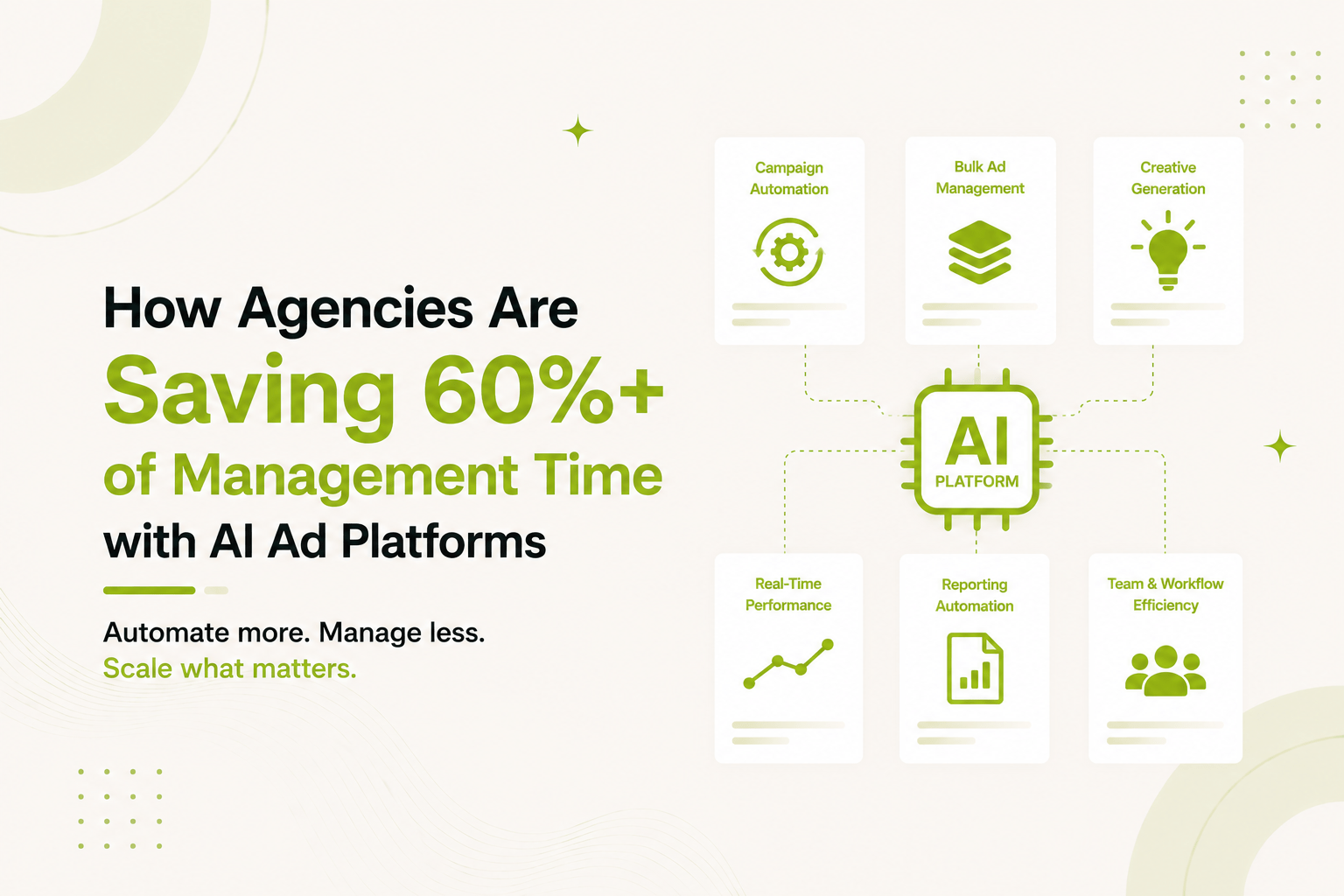
FabFunnel’s AI ad platform, delivered through its Bulk Campaign Launcher, addresses this directly. Campaign structure – objective, audience, budget, placement, creatives – is configured once and applied across hundreds of campaigns in a single launch. What takes 4-8 hours per client manually runs in under 2 minutes in bulk.
For agencies onboarding a new client, this changes the economics of the first campaign cycle. For agencies running weekly creative refreshes across 15 accounts, it removes the most time-intensive recurring task from the workload.
The platform supports Meta, TikTok, and NewsBreak in the same workflow – so cross-platform campaign management doesn’t require switching between platforms or rebuilding campaign structures per channel.
Automated Campaign Management
Daily monitoring and manual optimization are the largest single time category for most agencies – and the most interruptive.
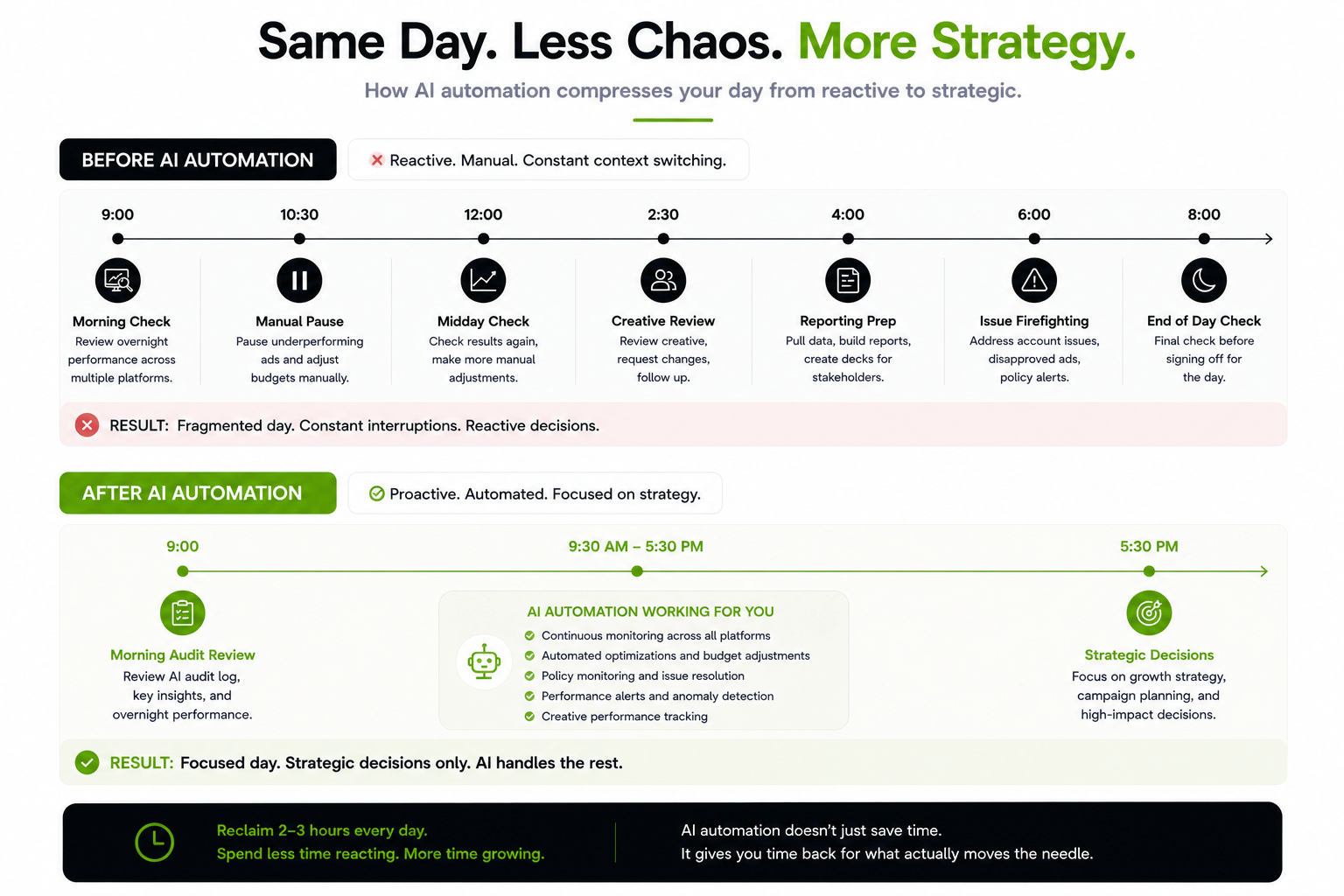
An ad set that crosses a CPA threshold on a Tuesday afternoon doesn’t wait for the morning review. Without automation, that either requires constant monitoring or accepts delayed response. With automation rules running 24/7, the system pauses the underperformer, scales the winner, or reallocates budget based on pre-configured conditions – without requiring a human to catch it first.
FabFunnel‘s AI ad platform runs its automation engine continuously at campaign, ad set, and ad level. Every automated action is logged – which rule fired, against which campaign, on what condition. The audit log replaces the daily monitoring cycle for routine decisions, and surfaces exceptions for human review rather than requiring manual review of everything.
Creative Production and Management
Creative fatigue is a constant pressure for agencies. Each client account needs fresh creative regularly – and the brief, production, review, upload, and naming cycle consumes significant time per variation.
AI creative generation through tools like FabFunnel’s Genie compresses the production cycle. Brief the generation run, review the output, select variations, and push to campaigns – without a designer, without a production timeline, and without a manual upload process. The creative connects directly to the campaign launcher.
For agencies managing creative across multiple client accounts, the Creative Library provides organized storage per account – reducing the time spent finding, managing, and versioning assets across the portfolio.
Consolidated Reporting
Pulling data from 15 separate Meta dashboards, 15 TikTok dashboards, and reconciling the numbers into client-facing reports is a significant time cost that produces no strategic value.
The AI ad platform’s multi-account reporting consolidates performance data across all connected accounts into a single view. For agencies, this means performance review happens in one place rather than across 30+ platform dashboards. The time saving compounds with account count – the more clients, the bigger the delta.
What 60% Time Savings Actually Means
The 60%+ figure isn’t universal – it reflects specific workflow improvements in the highest-time-cost categories. The agencies seeing the largest time savings are those where manual campaign setup, daily monitoring, and reporting were each consuming significant hours per week.
What 60% time savings enables:
Higher client capacity per account manager. A manager who handles 10 clients with manual workflows can often push to 15-20 on an AI platform, without working proportionally more hours. More revenue per person, same headcount.
Faster client onboarding. The first campaign cycle eats the most time with any new client. Bulk launch and automated setup turn that into hours instead of days, which lowers the cost of bringing someone on.
More strategic focus. Hours that used to go to monitoring, reporting, and setup free up for strategy, creative direction, and actually talking to the client – the stuff that keeps them around, not just keeps the campaigns running.
Lower cost per client. Reduced management time per account means lower delivery cost. For agencies competing on price, this creates margin. For agencies competing on value, it creates capacity to do more for each client within the same fee structure.
What AI Ad Platforms Don’t Replace
Being direct about the limits:
Client strategy and relationship management. Understanding what a client’s business needs, communicating performance clearly, managing expectations during tough periods – these are relationship and judgment tasks that don’t automate.
Creative direction. AI generates from briefs. Deciding what the brief should say – what angle, what audience insight, what offer framing – requires the strategic thinking that experienced account managers provide.
Complex troubleshooting. When an account has a policy issue, a billing problem, or an unusual performance anomaly, human judgment is required. Automation handles routine decisions; exceptions need people.
New platform strategy. Expanding a client into a new channel, restructuring their account for a new campaign objective, or rebuilding a strategy after a significant performance change are strategic activities that AI ad platforms support but don’t replace.
The Takeaway: Agency Scale Now Has More to Do With Workflow Than Headcount
The constraint on agency growth used to be headcount – more clients required more people, roughly proportionally. AI ad platforms have changed that relationship.
The agencies that have integrated bulk campaign launch, automated campaign management, AI creative generation, and consolidated reporting into their standard workflow are running at a client-to-headcount ratio that wasn’t achievable two years ago. The per-client time cost has dropped enough that the same team can serve a meaningfully larger portfolio.
That’s not a marginal efficiency gain. For agencies where growth was constrained by hiring capacity rather than client demand, it changes the economics of the business.
Frequently Asked Questions
How do AI ad platforms save agencies time?
The largest time savings come from four areas: bulk campaign launch (replacing manual setup across multiple accounts), automated campaign management (replacing daily monitoring with rules-based automation), AI creative generation (replacing manual production cycles), and consolidated reporting (replacing platform-by-platform data pulls).
What is the ai ad platform category?
AI ad platforms are tools that combine campaign workflow automation, AI creative generation, and multi-platform management into a unified system – distinct from standalone ad automation tools, standalone creative tools, or individual platform ad managers.
How many clients can one account manager handle with AI ad platform support?
This varies by agency type and account complexity, but teams using AI ad platforms for campaign management, creative, and reporting consistently report capacity increases of 50-100% – moving from 8-10 accounts per manager to 15-20 without a proportional increase in hours.
Does FabFunnel work for agencies managing multiple client accounts?
Yes. FabFunnel supports multi-account management across Meta, TikTok, and NewsBreak from a single platform. The Bulk Campaign Launcher, automation rules, and consolidated reporting are all built to work across multiple accounts simultaneously.
What should agencies look for when choosing the best AI ad platform?
Multi-account support (not just single-account tools), cross-platform campaign management (Meta and TikTok at minimum), integrated creative generation, automation rules with full audit logging, and consolidated reporting. The integration between these capabilities – not just each capability individually – is what produces the workflow efficiency at scale.
How long does it take to see time savings after adopting an AI ad platform?
The launch and reporting time savings are immediate – they show up in the first campaign cycle. Automation rules take 2-4 weeks to calibrate as you adjust conditions based on account-specific performance patterns. Creative generation workflow saves appear within the first 30 days as the team builds proficiency with brief quality and review process.