Strategy without execution is a document. Execution without strategy is noise.
The teams getting the most from AI marketing in 2026 aren’t the ones who’ve adopted the most tools. They’re the ones who’ve made deliberate decisions about where AI replaces manual work, where it augments human judgment, and what that means for how their marketing operates end to end.
This guide covers how to build an ai marketing strategy that’s grounded in business outcomes rather than tool adoption – with the specific decisions, frameworks, and applications that separate a coherent strategy from a collection of AI experiments. If you’re collecting ai marketing ideas or trying to formalize tactics that already work, the framework below gives you a concrete starting point.
What an AI Marketing Strategy Actually Is
An ai marketing strategy is a plan for how AI capabilities get integrated into your marketing workflow to achieve specific business outcomes – faster growth, lower acquisition cost, higher creative output, better campaign efficiency.
It’s not a list of AI tools you’re using. It’s not “we use AI for everything now.” It’s a set of deliberate choices about which parts of marketing get AI applied to them, what the decision criteria are for each, and how the workflow changes as a result.
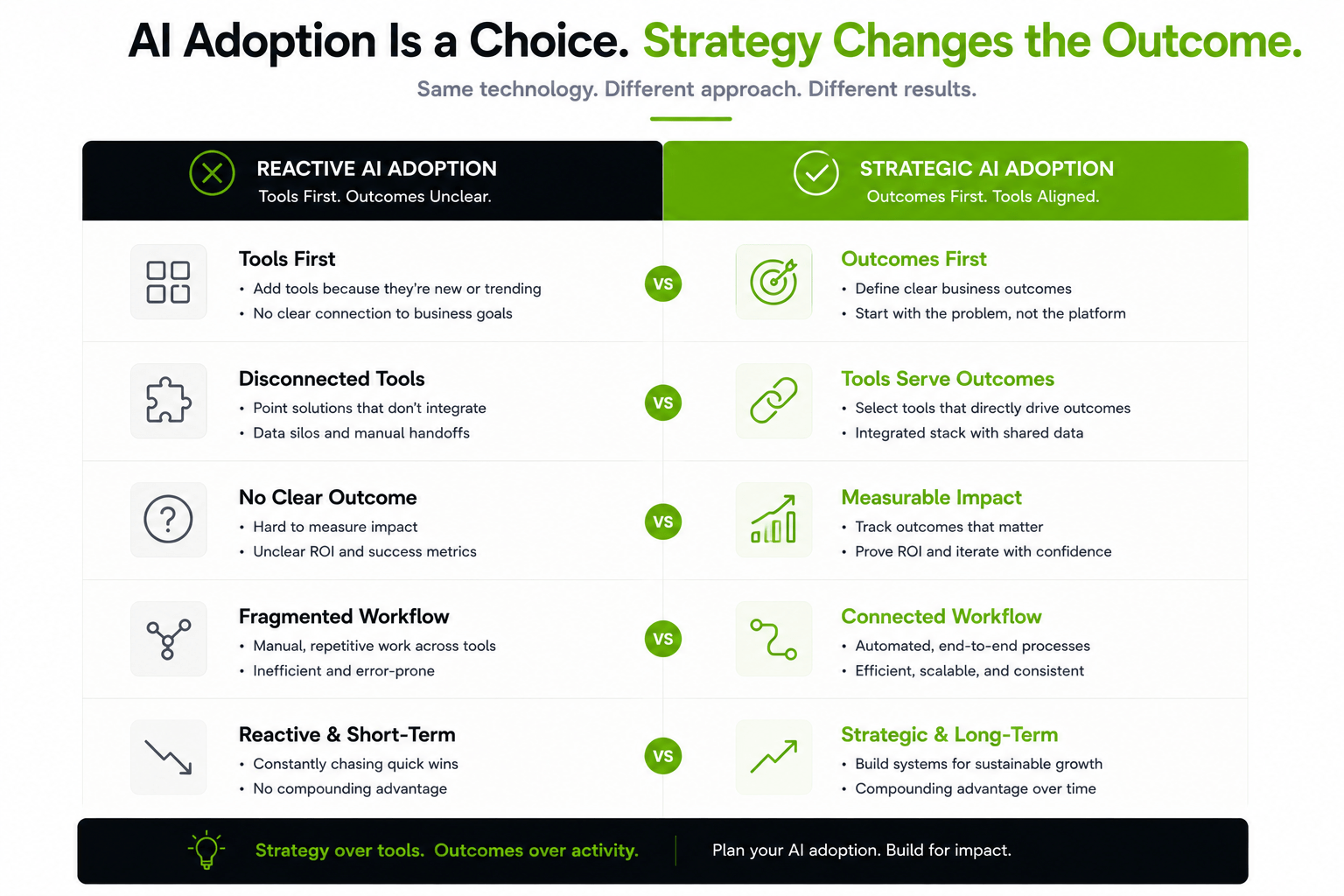
The distinction matters because most teams approach AI marketing reactively – they adopt tools as they hear about them, run some experiments, and end up with a scattered set of capabilities that don’t connect into a coherent system. The result is overhead without leverage.
A strategy starts with outcomes and works backward to tools. Not the other way around.
The Framework: Where AI Applies in Marketing
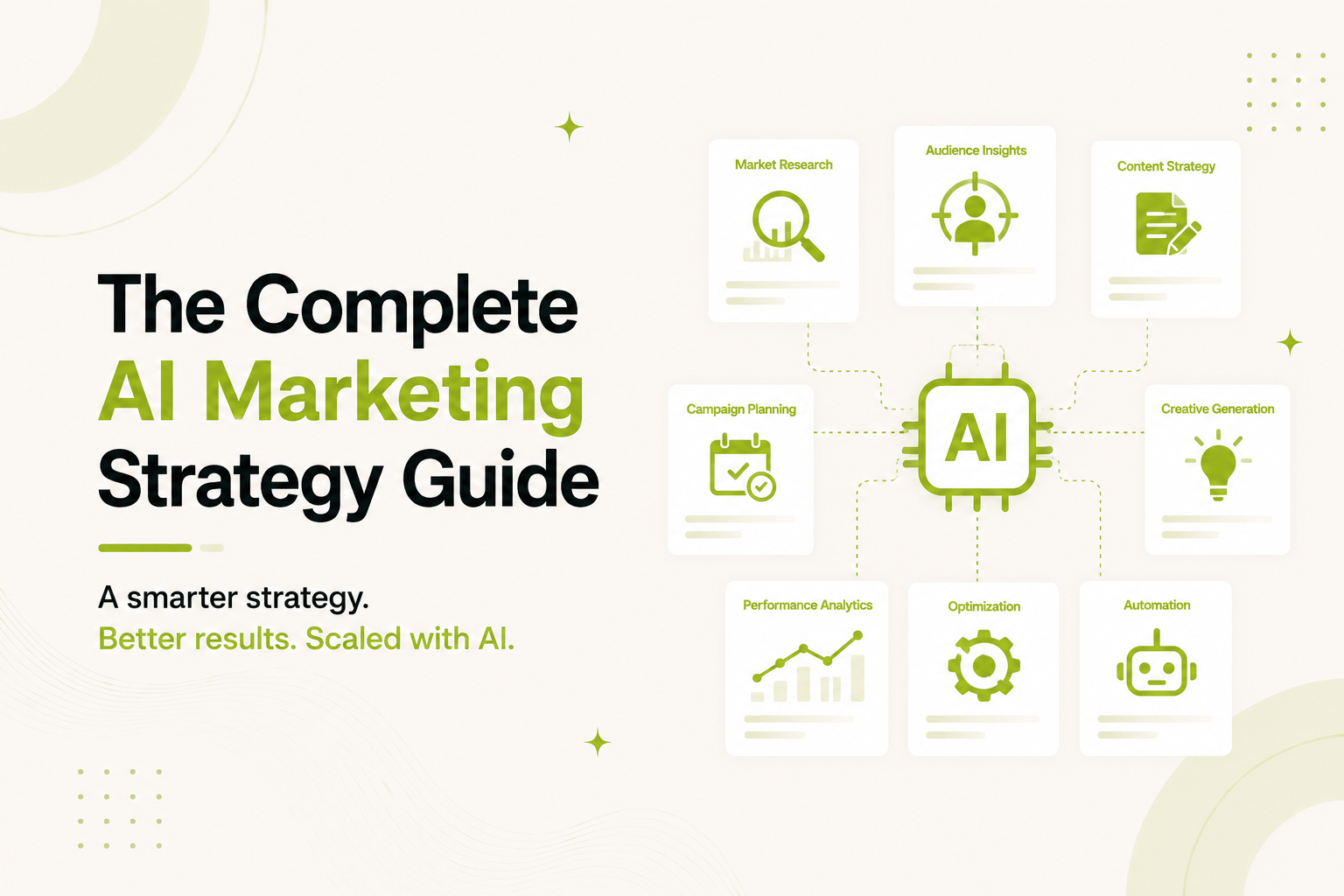
Marketing has four functional layers where AI currently creates meaningful leverage. A coherent strategy addresses each one explicitly.
1. Intelligence – What You Know Before You Act
The intelligence layer covers everything that informs decisions before campaigns are built: competitor research, market analysis, audience insight, and creative performance data.
AI applications here include competitor ad intelligence (what’s running in your market, what formats are being invested in, what angles are working), creative analysis (which elements of your own top-performing ads drove the result), and audience signal processing (what behavioral data tells you about who’s actually converting).
The strategic question: how are you collecting intelligence before you build campaigns, and what specifically feeds your briefs?
Teams without this layer are starting from intuition. Teams with it are starting from evidence. The brief quality difference compounds over every campaign cycle.
2. Production – What You Create
The production layer covers the creation of marketing assets: ad creative, landing page copy, email content, organic social, and any other content that reaches an audience.
AI applications here include creative generation (image ads, video ads, ad copy across formats), content production (blog posts, email sequences, social content), and format adaptation (taking one piece of content and producing platform-specific versions without starting from scratch).
The strategic question: where is production currently the bottleneck, and what volume does the production system need to support the testing cadence the strategy requires?
Most teams underestimate the production volume their testing strategy requires. A/B testing at scale, creative refresh cycles, and multi-platform distribution all have production requirements that manual processes can’t meet without significant headcount.
3. Execution – How Campaigns Go Live
The execution layer covers campaign setup, launch, and the operational infrastructure that puts campaigns in market – audience configuration, campaign structure, bid strategy, placement selection, and the launch process itself.
Three things AI handles here: bulk campaign launch (one configuration, live across platforms at once), automation rules (auto-pause, auto-scale, budget reallocation off real-time signals), and cross-platform management (same campaign logic on Meta, TikTok, and elsewhere, no rebuilding from scratch each time).
The strategic question: how much of campaign setup and management is currently manual, and what is that manual work costing in terms of time and execution accuracy?
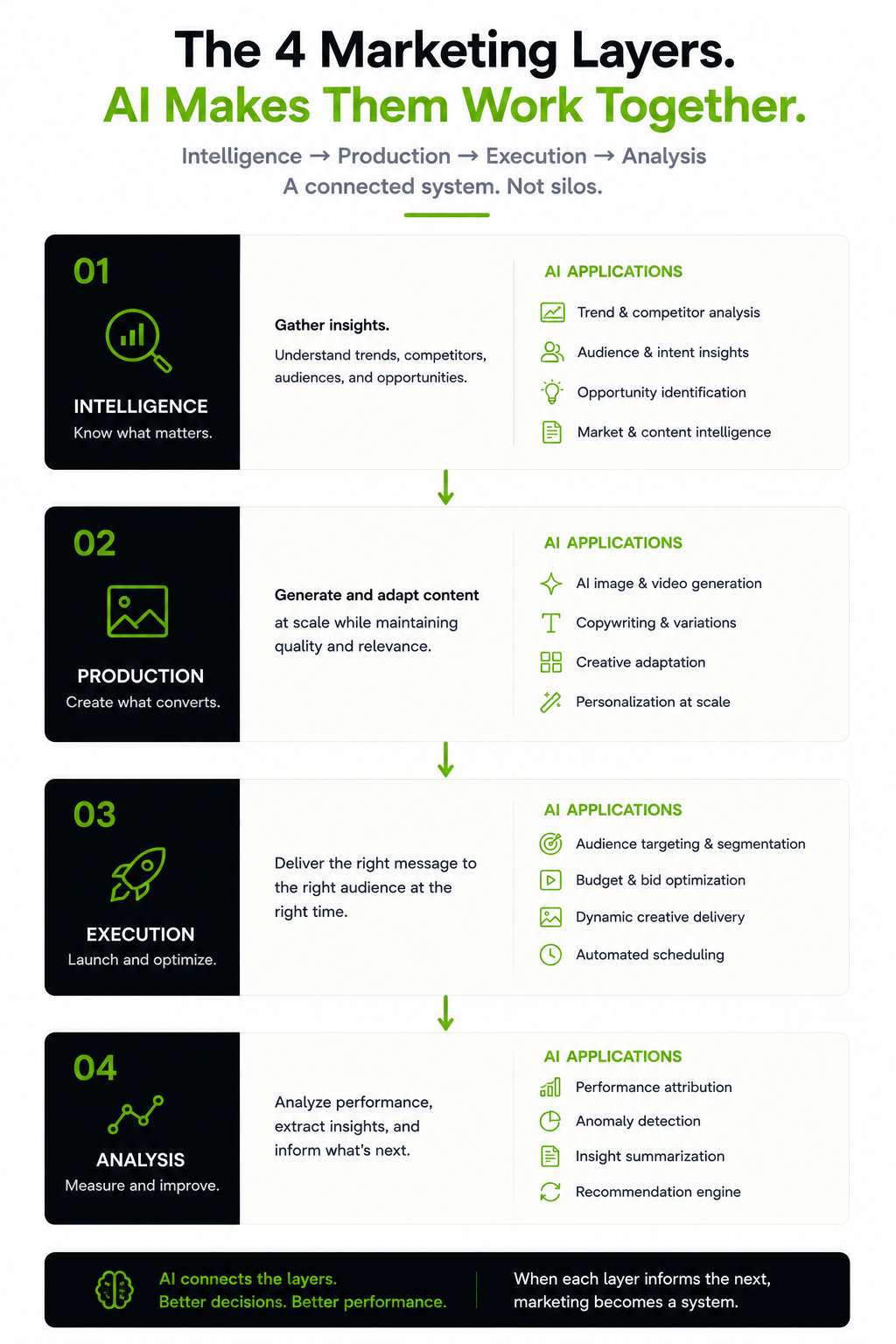
4. Analysis – What You Learn
The analysis layer covers measurement, attribution, and the extraction of learnings that feed back into the next cycle – intelligence, production, and execution decisions all improve with better analysis feeding them.
AI applications here include multi-touch attribution (understanding which touchpoints actually drive conversion rather than defaulting to last-click), creative performance analysis (element-level breakdown of what drove winning creative results), and automated reporting (surfacing the signals that require action without requiring manual review of all data).
The strategic question: what are you learning from each campaign cycle, and how specifically does that learning change your next brief, your next production run, and your next campaign structure?
Building Your AI Marketing Strategy
Turning the framework above into an ai marketing plan takes four deliberate steps, the same steps that turn any ai marketing strategy from theory into workflow.
Step 1: Audit the Current State
Before adopting new AI capabilities, map where your marketing is today across all four layers. For each layer, identify:
- What’s done manually and how long it takes
- Where the quality or output is inconsistent
- Where production or execution is the bottleneck relative to your growth goals
This audit produces your leverage map – the specific places where AI creates the most value in your operation. The gaps that cost you the most in time, quality, or scale are where to apply AI first.
Step 2: Define Outcomes Before Tools
For each layer where you’ve identified leverage, define the outcome you want before selecting the tool. The outcome should be specific and measurable.
Not: “we want to use AI for creative.” Rather: “we want to increase the number of creative variations we test per month from 8 to 40, reducing the time per variation from 3 hours to 30 minutes.”
That outcome tells you what the tool needs to do. The tool selection follows from the outcome – not the other way around.
Step 3: Start With One Layer at Full Depth
The most common mistake in AI marketing strategy is spreading adoption across all four layers at shallow depth. Better to go deep on one layer – fully integrating AI into production, for example – than to add light AI capability across all four simultaneously.
Full depth means the AI capability is part of your standard operating procedure, not a tool you use sometimes. It means the output is consistently better than what you had before. It means the team knows how to use it well, not just in theory.
One layer fully integrated compounds faster than four layers partially adopted.
Step 4: Connect the Layers
Once individual layers are solid, the compound value comes from connecting them. Intelligence feeding production briefs. Production output feeding execution. Analysis from execution feeding intelligence for the next cycle.
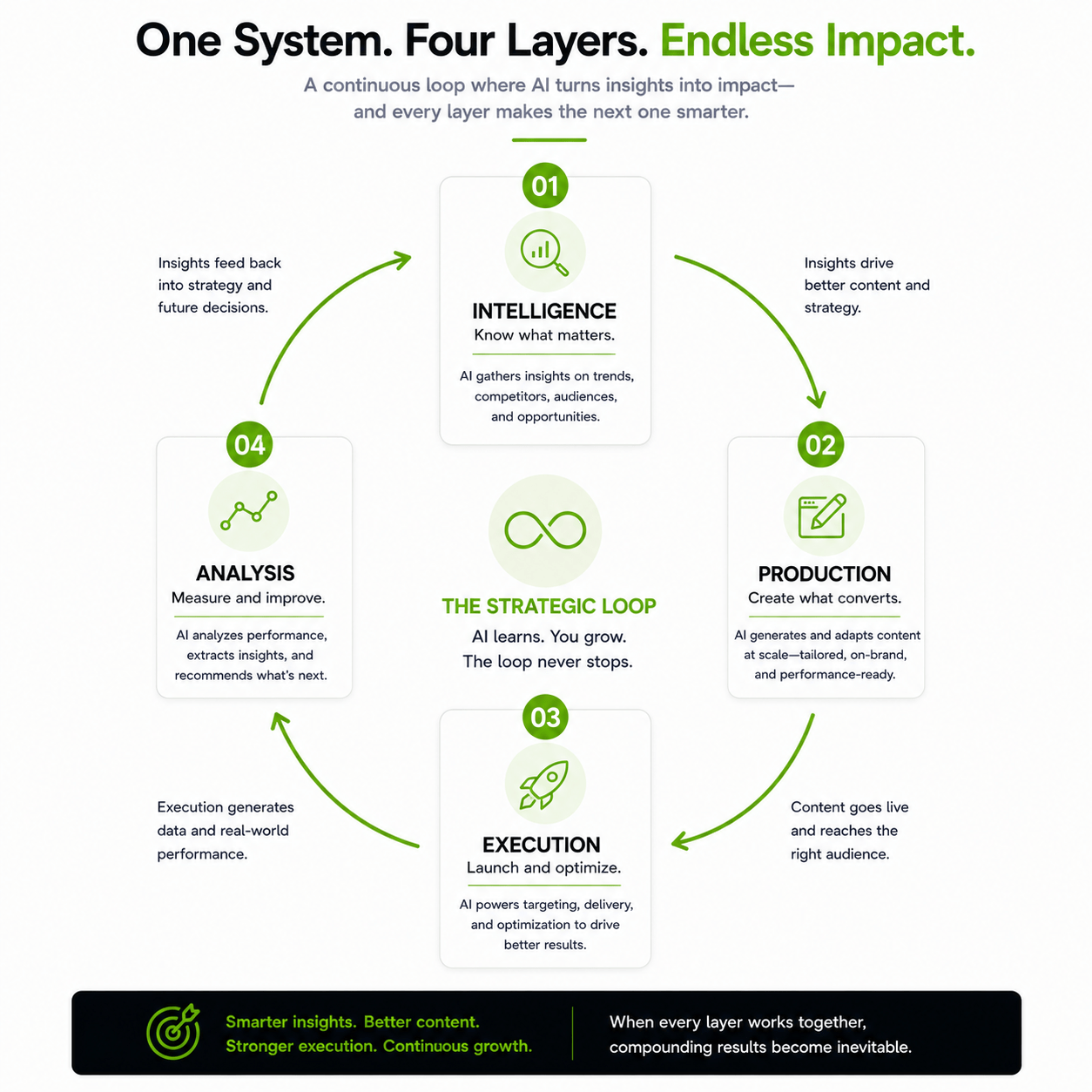
The workflow that emerges is a connected system rather than a set of independent tools. Each step’s output improves the next step’s input. The learning cycle gets faster with every iteration.
Where FabFunnel Fits in an AI Marketing Strategy
FabFunnel covers three of the four layers within a single platform:
Intelligence – Industry Insights surfaces competitor ad data for Meta, informing briefs before production starts. Video Sage analyzes existing creative performance at the element level.
Production – Genie generates image and video ad creative across multiple formats (UGC-style, product showcase, testimonial, offer-driven, founder-led) from a structured brief. Creative Library stores and organizes the output.
Execution – Bulk Campaign Launcher pushes 200+ campaigns live in under 2 minutes across Meta, TikTok, and NewsBreak. Automation rules run 24/7 at campaign, ad set, and ad level.
The integration between these layers – competitor insight feeding the Genie brief, generated creative moving directly to the Bulk Launcher, automation rules acting on what launches – is what produces the workflow compound effect a coherent AI marketing strategy requires.
The Takeaway: AI Marketing Strategy Is About Workflow, Not Tool Count
The most effective marketing strategy ai enables today isn’t defined by tool count; it’s defined by workflow.
The teams building durable advantages with AI marketing in 2026 are not the ones with the most tools. They’re the ones with the most connected workflows – where each layer informs the next, where intelligence improves production, where production feeds execution, and where analysis loops back into the beginning.
That connection is what a real ai marketing strategy looks like. Not a collection of AI experiments. A system.
Frequently Asked Questions
What is an AI marketing strategy?
An AI marketing strategy is a deliberate plan for integrating AI capabilities into your marketing workflow to achieve specific outcomes – lower acquisition cost, higher creative volume, faster testing cycles, more efficient campaign management. It starts with outcomes and works backward to tools, rather than adopting tools and hoping outcomes follow.
Where should a marketing team start with AI adoption?
Start with an audit of where manual work is the biggest bottleneck relative to your growth goals. For most performance marketing teams, that’s creative production or campaign setup. Adopt AI at full depth in that one area before expanding to others.
How do you measure whether an AI marketing strategy is working?
Measure the specific outcome you defined before adoption – cost per variation, time per campaign setup, creatives tested per month, cost per result. If the metric hasn’t moved after 60 days, the implementation isn’t working, regardless of the tool’s capabilities.
What’s the difference between an AI marketing tool and an AI marketing strategy?
A tool is a capability. A strategy is a plan for how capabilities connect to outcomes. Teams that have tools but no strategy end up with overhead. Teams that have a strategy use tools selectively to remove specific bottlenecks and build workflows that compound.
How does AI change marketing team structure?
AI removes the need for headcount in production-heavy roles – graphic design for performance ads, campaign setup for high-volume accounts, manual reporting. It increases the leverage of strategic roles – creative direction, brief quality, audience intelligence, performance analysis. Teams shift from production-heavy to judgment-heavy.
What AI marketing capabilities have the highest ROI?
Based on current adoption patterns: creative generation (directly increases testing volume and reduces time to market), campaign automation (reduces management overhead at scale), and competitor intelligence (improves brief quality before production starts). Attribution analytics are high-value for teams with multi-channel spend where understanding true performance is currently a problem.