Performance marketing runs on speed, data, and creative volume. The tools that have become essential in 2026 are the ones that accelerate all three – cutting the time between a campaign idea and live test, making performance data actionable faster, and removing the production ceiling on creative output. In practice, that’s what AI for performance marketing is built to do.
This guide covers the best AI tools for performance marketing in 2026 – organized by the function they serve, not just the category they claim to be in. Choosing the right AI for performance marketing means matching each tool to the bottleneck that’s actually slowing your team down.
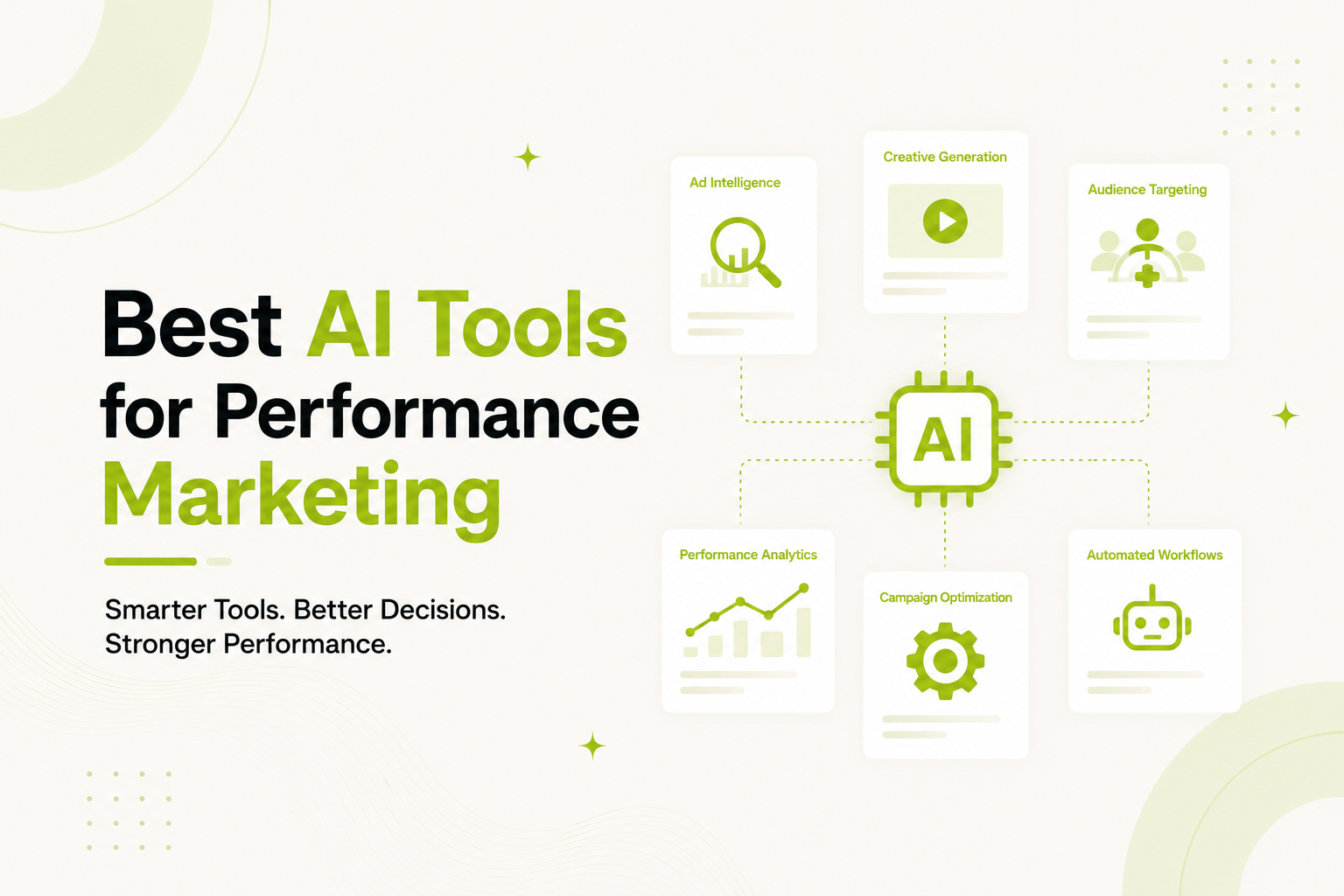
In short, the best AI tools for performance marketing cover five jobs: creative generation, campaign launch and automation, competitor intelligence, analytics and reporting, and video analysis. The best performance marketing tools are the ones that remove your biggest bottleneck, and the table below lists all 13 tools for performance marketing covered in this guide.
| Tool | Category | What it does |
|---|---|---|
| FabFunnel Genie | Creative generation | Generates image and video ad creatives from a structured brief |
| AdCreative.ai | Creative generation | Static image ad generation with platform-specific variations |
| Pencil | Creative generation | Creative generation with built-in performance prediction |
| FabFunnel Bulk Campaign Launcher | Campaign launch and automation | Launches campaigns in bulk across Meta, TikTok, and NewsBreak from one configuration |
| FabFunnel Automation | Campaign launch and automation | Rules-based automation at campaign, ad set, and ad level, running 24/7 |
| Revealbot | Campaign launch and automation | Automation rules for Meta and Google |
| FabFunnel Industry Insights | Competitor intelligence | Competitor ad discovery and tracking for Meta |
| Minea | Competitor intelligence | Ad spy tool covering Meta, TikTok, and Pinterest |
| BigSpy | Competitor intelligence | Ad spy across Meta, TikTok, YouTube, and native ad networks |
| Northbeam | Analytics and reporting | Multi-touch attribution across channels |
| Triple Whale | Analytics and reporting | Ecom-focused attribution and analytics |
| FabFunnel Reporting | Analytics and reporting | Multi-ad account reporting in a single dashboard |
| FabFunnel Video Sage | Video analysis | Analyzes existing video ad creative to inform the next brief |
What Makes an AI Tool Actually Useful for Performance Marketing
The performance marketing context filters out a lot of tools that work fine in other applications. It’s also what separates generic software from AI for performance marketing built specifically for this use case.
A tool is useful in performance marketing if it directly affects one of three outcomes: how fast you can get a campaign live, how efficiently your budget converts, or how much you learn per dollar spent. Tools that improve workflow without affecting any of these are overhead with a better UI. That’s the bar every piece of AI for performance marketing has to clear before it earns a place in your stack.
The specific requirements for performance contexts:
- Works with Meta, TikTok, or other performance platforms natively – not just as a standalone tool
- Produces output at the volume performance testing requires – not just one or two variations
- Connects to campaign data rather than operating in isolation
- Reduces time to action, not just time to insight
With that filter applied, here are the tools doing the actual work.
Creative Generation
FabFunnel Genie
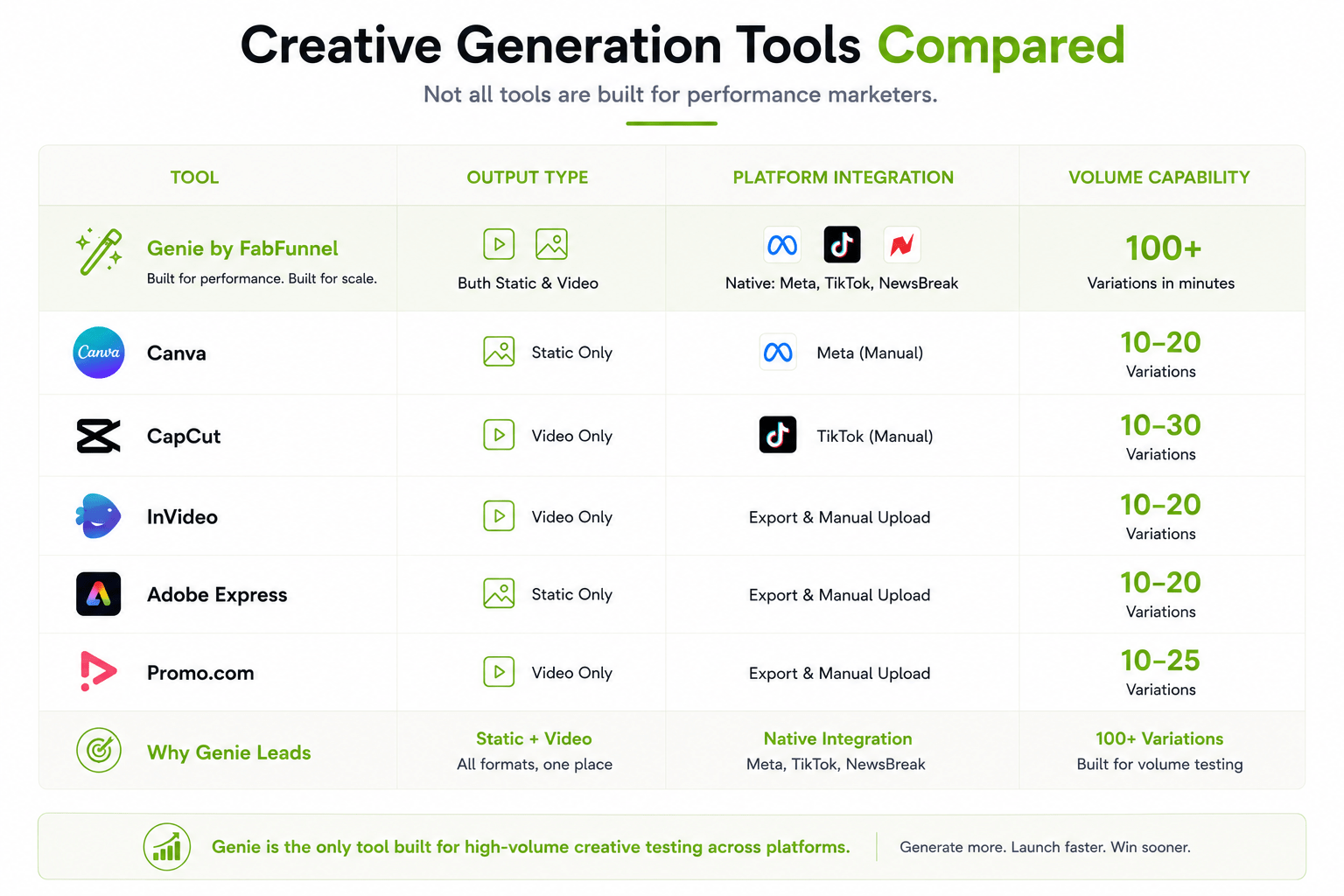
Genie generates image and video ad creatives from a structured brief – UGC-style, product showcase, testimonial, offer-driven, and founder-led formats. Output connects directly to FabFunnel’s campaign launcher so there’s no manual export. For teams running volume creative testing on Meta and TikTok, this removes the production bottleneck between a creative hypothesis and a live test. Catalogue integration means ecom brands can pull product data directly into briefs without manual entry. It’s a clear example of AI for performance marketing applied to creative production.
AdCreative.ai
Focused on static image ad generation. Strong for ecom and direct response formats. Produces platform-specific variations at scale and connects to ad accounts for performance data feedback. Useful as a high-volume static generation tool alongside video-focused generation platforms. It’s another option for teams exploring AI for performance marketing focused purely on static creative.
Pencil
AI creative generation with built-in performance prediction. Analyzes existing top-performing ads from your account and generates new variations informed by that data. The prediction layer is imperfect but directionally useful – particularly for teams that want generation and analysis in the same tool. This blend of generation and prediction is increasingly common in AI for performance marketing.
Campaign Launch and Automation
FabFunnel Bulk Campaign Launcher
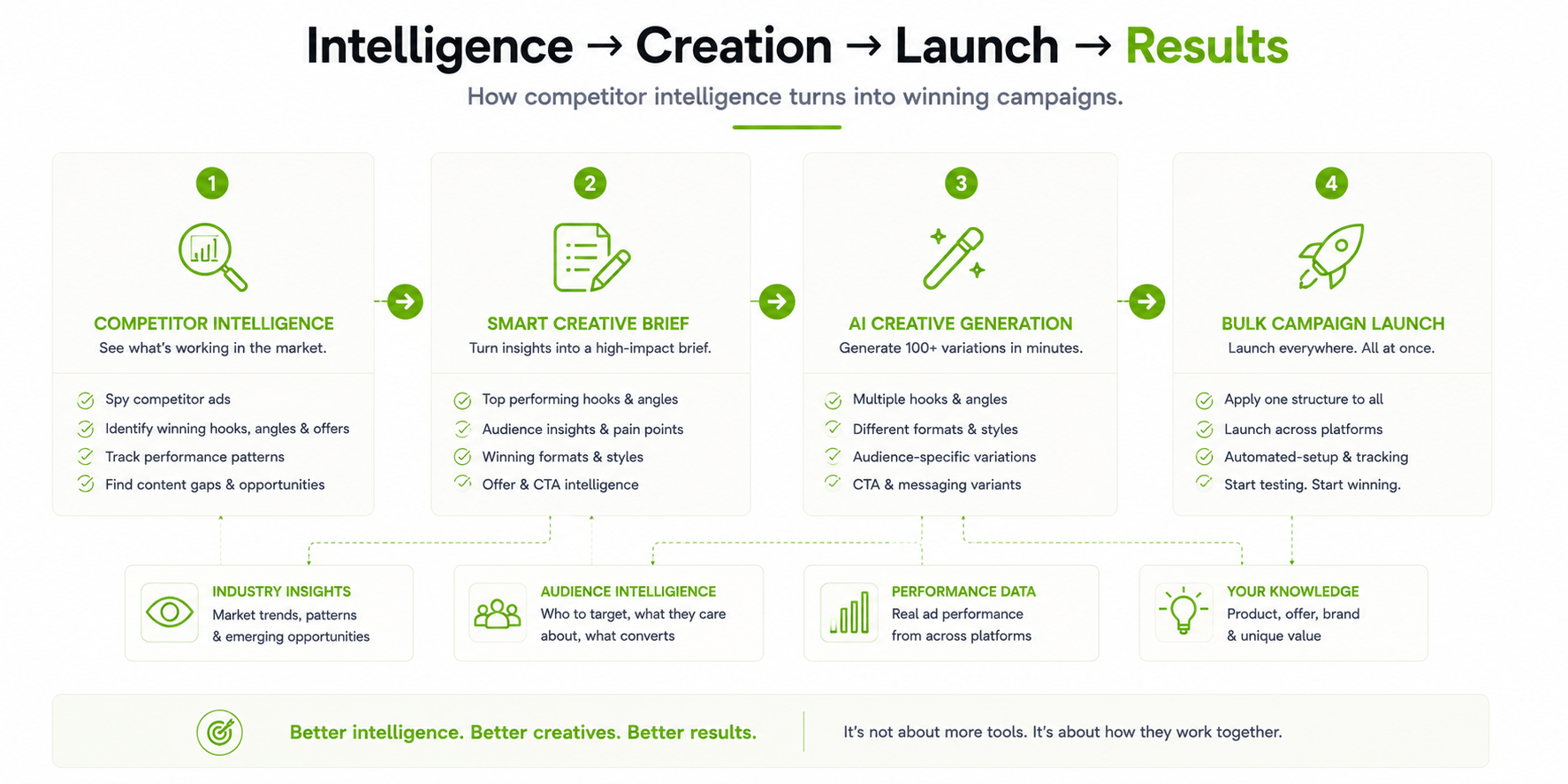
Launches 200+ campaigns in under 2 minutes across Meta, TikTok, and NewsBreak from a single campaign configuration. For media buyers, affiliates, and agencies running high-volume campaigns, this removes the manual setup tax on every launch. Campaign structure – objective, audience, budget, placements, creatives – is configured once and applied in bulk. That kind of bulk execution is where AI for performance marketing saves the most operational time.
FabFunnel Automation
Rules-based automation that runs 24/7 at campaign, ad set, and ad level. Define conditions – CPA floors, ROAS thresholds, frequency caps – and the system executes across every account in your portfolio without manual review. Every action is logged. Covers auto-pause, auto-scale, and budget reallocation based on performance signals. This kind of performance marketing automation keeps campaigns within guardrails without needing someone to watch dashboards all day. It’s a practical demonstration of AI for performance marketing running unattended.
Revealbot
Automation rules for Meta and Google. Strong rule-building interface, useful for teams that want granular control over automation conditions. Covers the core auto-pause and auto-scale use cases well. Less strong on cross-platform execution compared to dedicated multi-platform tools. Still, it holds up as a solid entry point into AI for performance marketing for smaller teams.
Competitor Intelligence
FabFunnel Industry Insights
Competitor ad discovery and tracking for Meta. See what ads competitors are running, how long they’ve been running them (a proxy for what’s working), and what creative formats are in rotation in your niche. Useful at the brief-building stage – informing hook types and creative angles based on what’s already performing in the market. This kind of intelligence gathering is a foundational use of AI for performance marketing.
Minea
Ad spy tool covering Meta, TikTok, and Pinterest. Broad inventory of competitor ads with filtering by engagement, format, and niche. Useful for initial market research and creative direction. Many teams use it as a lightweight starting point for AI for performance marketing.
BigSpy
Wide platform coverage including Meta, TikTok, YouTube, and native ad networks. Useful for affiliates and media buyers working across multiple networks who need a single intelligence tool rather than platform-specific ones. It fills that role well within a broader AI for performance marketing stack.
Analytics and Reporting
Northbeam
Multi-touch attribution for performance marketers running across Meta, TikTok, Google, and other channels. Addresses the attribution problem that becomes acute when iOS privacy changes make platform-reported data less reliable. Useful for understanding true channel contribution beyond last-click.
Triple Whale
Ecom-focused attribution and analytics. Strong on connecting ad spend to actual revenue at the SKU level. Particularly useful for brands running multiple products across multiple channels who need to reconcile platform data with Shopify revenue.
FabFunnel Reporting
Multi-ad account reporting across Meta, TikTok, and NewsBreak in a single dashboard. For agencies and teams managing multiple accounts, this removes the context-switching between native platform dashboards and provides a consolidated view of performance across the portfolio.
Video Analysis
FabFunnel Video Sage
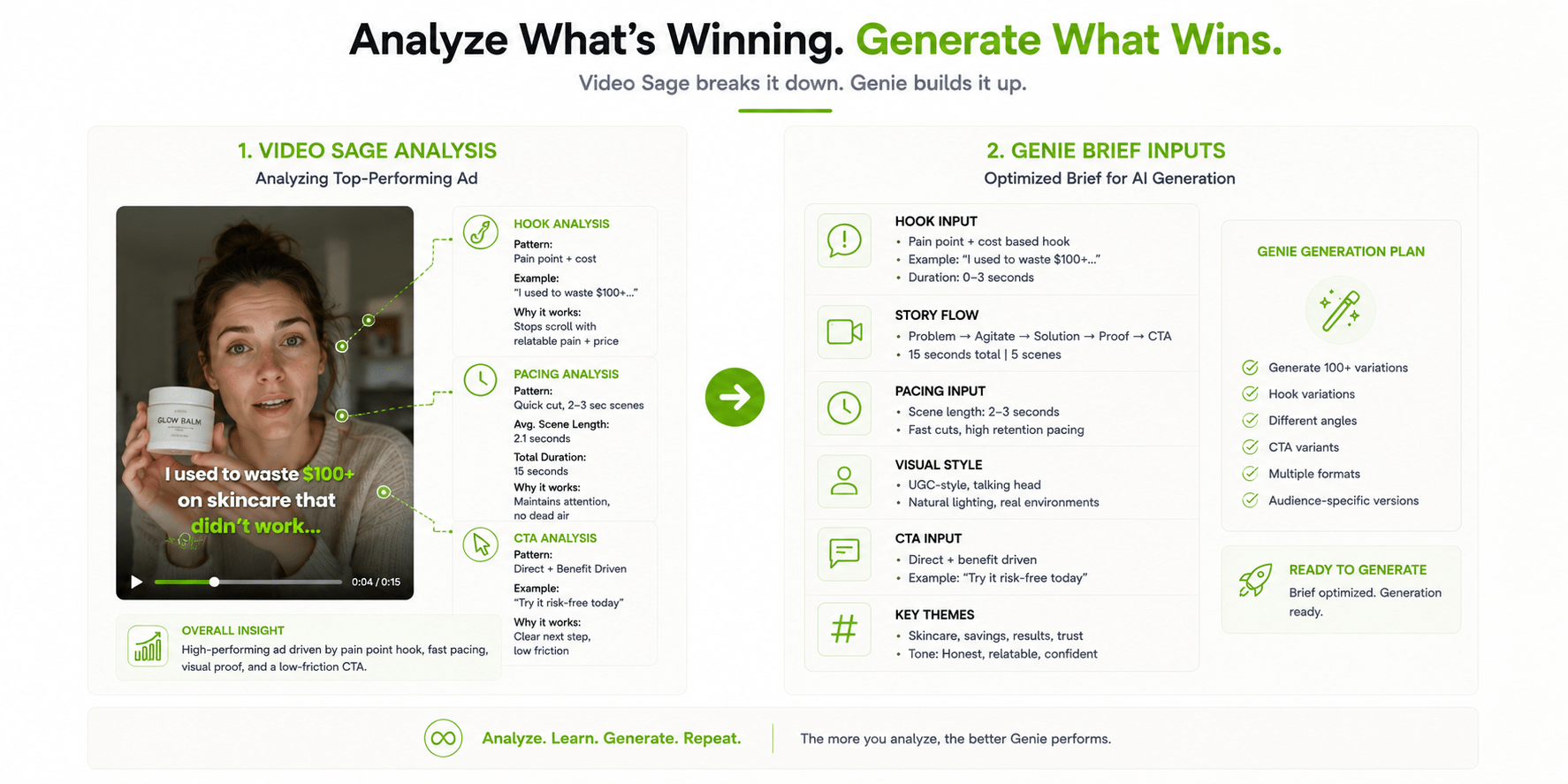
Analyzes existing video ad creative to identify which elements – hook type, pacing, CTA placement, visual treatment – correlate with performance. The analysis informs the brief for the next generation run, connecting creative analysis directly to production. Useful for teams that want to build on what’s working rather than generating blind.
How to Choose What to Add to Your Stack: Tools for Performance Marketing
A few practical filters before buying new tools:
Start with your biggest bottleneck. If creative production is the constraint, prioritize generation tools. If campaign setup is eating hours, prioritize launch automation. If you’re flying blind on attribution, prioritize analytics. Adding tools that don’t address your actual constraint produces cost without leverage. The right tools for performance marketing pay for themselves through leverage, not through feature count.
Prioritize tools that connect to each other. A creative generation tool that requires manual export to your campaign platform is slower than one that connects directly. Integrated stacks compound – each tool’s output feeds the next step without friction.
Measure against output, not features. The question isn’t what a tool can do in a demo. It’s whether it produces better campaign performance, faster learning cycles, or lower operational overhead in your actual workflow. Judged by that standard, AI for performance marketing is a means to an outcome, not an end in itself.
The Takeaway: The Best AI Tools for Performance Marketing Are the Ones That Compress the Learning Cycle
The performance marketing teams pulling ahead in 2026 aren’t using more tools. They’re using tools that make each step of the workflow – creative production, campaign launch, optimization, analysis – faster and more connected to the next step.
The compounding effect is real. Faster creative production means more tests. More tests mean more data. More data means faster learning. Faster learning means more budget going toward what works. That cycle tends to run faster for teams with integrated AI tooling than for teams operating each step manually or in isolation. In practice, the best performance marketing tools are simply the ones your team keeps using once the novelty wears off.
Ready to put it to work? Start your free trial or try Fab AI to generate creative, launch campaigns, and run performance marketing automation across Meta, TikTok, and NewsBreak from one place.
Frequently Asked Questions
What Are the Most Important AI Tools for Performance Marketing?
The highest-leverage categories are creative generation (to increase testing volume), campaign automation (to act on performance signals without manual review), and attribution analytics (to understand what’s actually driving results). Tools in these three categories have the most direct impact on campaign performance and operational efficiency. This is why many conversations about AI for performance marketing start with these three categories.
Do AI Tools for Performance Marketing Work With Meta and TikTok?
The best ones do. Native platform integration – connecting directly to ad accounts rather than operating as standalone tools – is what separates genuinely useful performance tools from general AI tools that happen to produce ad-related output.
How Much Do AI Tools for Performance Marketing Cost?
Pricing varies significantly by tool and usage tier. Creative generation tools often range from roughly $50-500 per month depending on output volume. Attribution platforms like Northbeam and Triple Whale are priced based on ad spend, often around 0.5-1% of managed spend. FabFunnel’s Growth Plan starts at $349 per month for the full campaign workflow stack. Check each vendor’s current pricing before you budget.
Can Small Performance Marketing Teams Benefit From AI Tools?
Yes – in some ways more than large teams. The leverage is highest where headcount is lowest. A single performance marketer using AI for creative generation, campaign automation, and competitor intelligence can get closer to the output of a much larger team without proportional cost.
What’s the Difference Between AI Automation and Rule-Based Automation in Performance Marketing?
Rule-based automation is fixed logic – CPA crosses X, pause the ad set. AI automation is more of a moving target: it picks up on patterns in performance and reacts to context a flat threshold would miss. Many tools you’d actually use in practice run both at once.
How Do I Evaluate Whether an AI Tool Is Actually Improving My Performance?
Define a baseline before you adopt the tool – your average cost per result, creative output volume, campaign setup time, or whichever metric the tool is supposed to affect. Measure the same metric 30-60 days after adoption. If it hasn’t moved, the tool isn’t working in your context regardless of what it does in others.
What Is AI for Performance Marketing?
AI for performance marketing is the use of AI to speed up the three things performance marketing runs on: creative volume, campaign execution, and data analysis. It cuts the time between a campaign idea and a live test and makes performance data actionable faster.
What Is Performance Marketing Automation?
Performance marketing automation is software that runs campaign actions for you, such as auto-pause, auto-scale, and budget reallocation, based on conditions or performance signals you set. It keeps campaigns within guardrails without someone watching dashboards all day.
What Are the Best Performance Marketing Tools?
The best performance marketing tools remove your biggest bottleneck: creative generation if production is the constraint, launch automation if setup is eating hours, or attribution analytics if you are flying blind. Pick the ones that connect to each other and that your team keeps using.