Creative agencies built their value on two things: access to production talent and time to produce. Both of those have been disrupted.
Generating ads with AI doesn’t require a design team, a video editor, or a three-week production timeline. For performance marketers focused on direct response, the workflow has compressed to the point where a single person with a strong brief and the right tools can produce a week’s worth of ad creative in a morning.
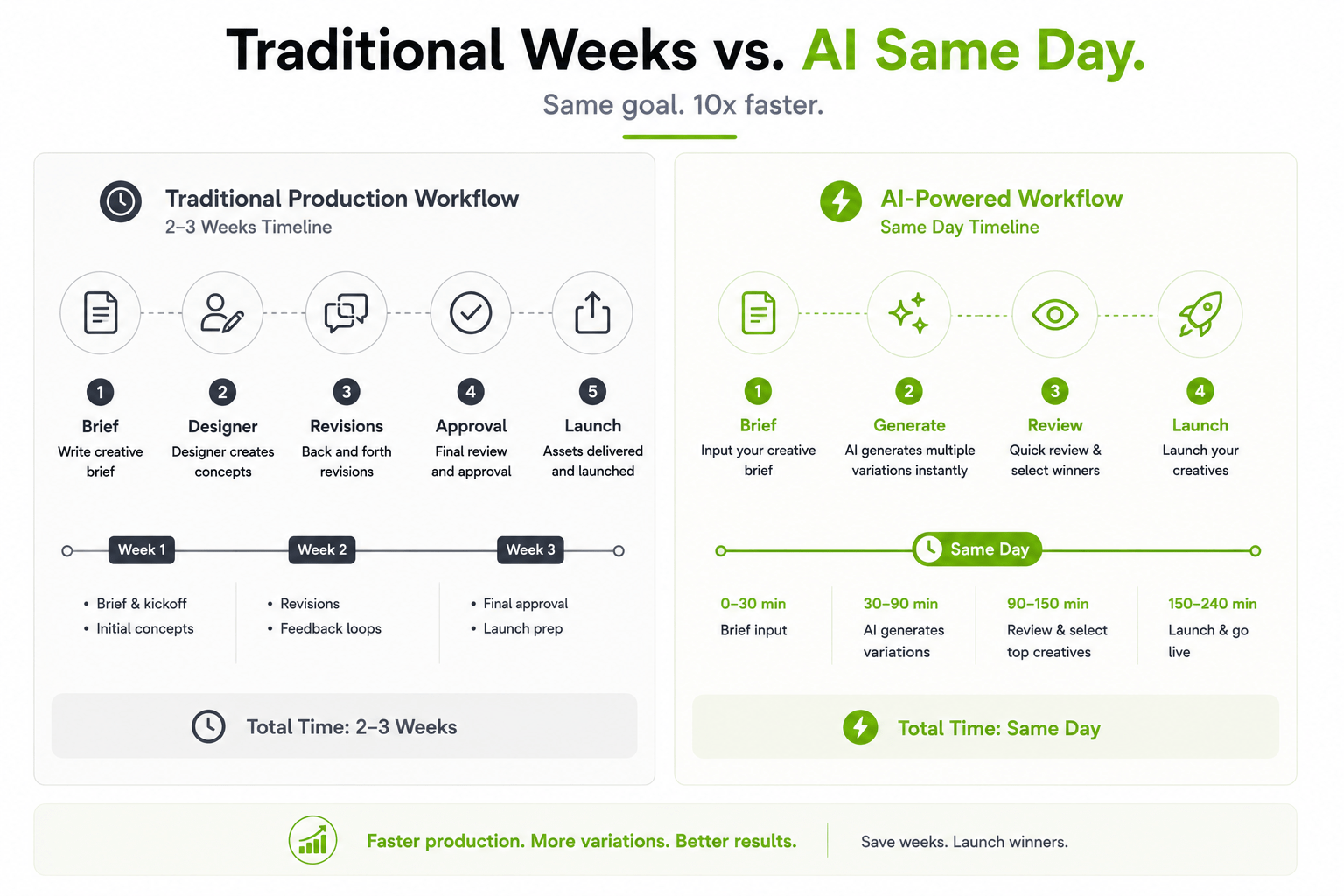
This isn’t about AI replacing creative thinking. It’s about AI removing the production bottleneck between a creative idea and a live ad. Here’s what that workflow actually looks like in 2026. Once you start to generate ads with AI, that workflow becomes the new baseline for how creative gets made.
Why the Old Creative Production Model Doesn’t Work at Scale
The traditional creative production model was built for a different volume requirement.
When you needed 4-6 ads per month, a design-review-revision-approve cycle made sense. The timeline was acceptable because the volume was manageable. Nobody needed to generate ads with AI at that pace.
The volume requirement has changed. Meta recommends 10-20 creative variations per ad set, and teams that generate ads with AI are hitting that volume without adding headcount. TikTok rewards weekly refreshes. Affiliate marketers running multiple offers need variation sets for each. Ecom brands testing new products need creative before they know which SKU will win.
At that volume, the traditional model doesn’t just slow you down – it becomes a fundamental constraint on how fast you can grow. The bottleneck isn’t budget or strategy. It’s creative production. This is why so many teams now create ads using AI instead of waiting on a traditional production cycle. The ability to generate ads with AI is what removed that bottleneck.
The AI Ad Generation Workflow in 2026
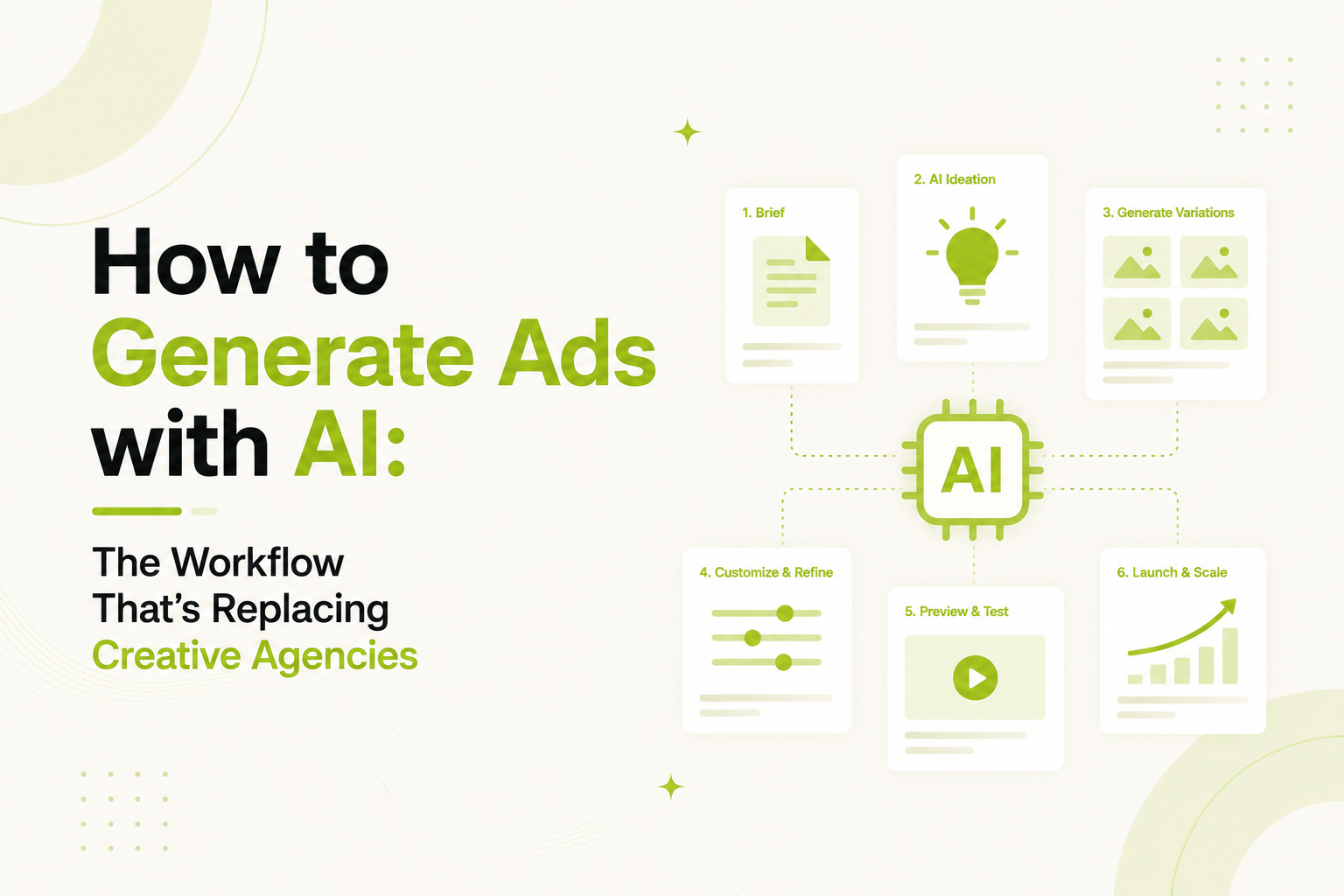
Step 1: Build a Brief That Works
Every strong AI-generated ad starts with a brief that’s specific enough to be useful. The AI generates from context – vague input produces vague output. Whether you generate ads with AI for a single product launch or an entire catalog, the brief is what determines quality.
A brief for generating ads with AI should include:
- The product or offer and its core benefit
- The target audience and their primary pain point or motivation
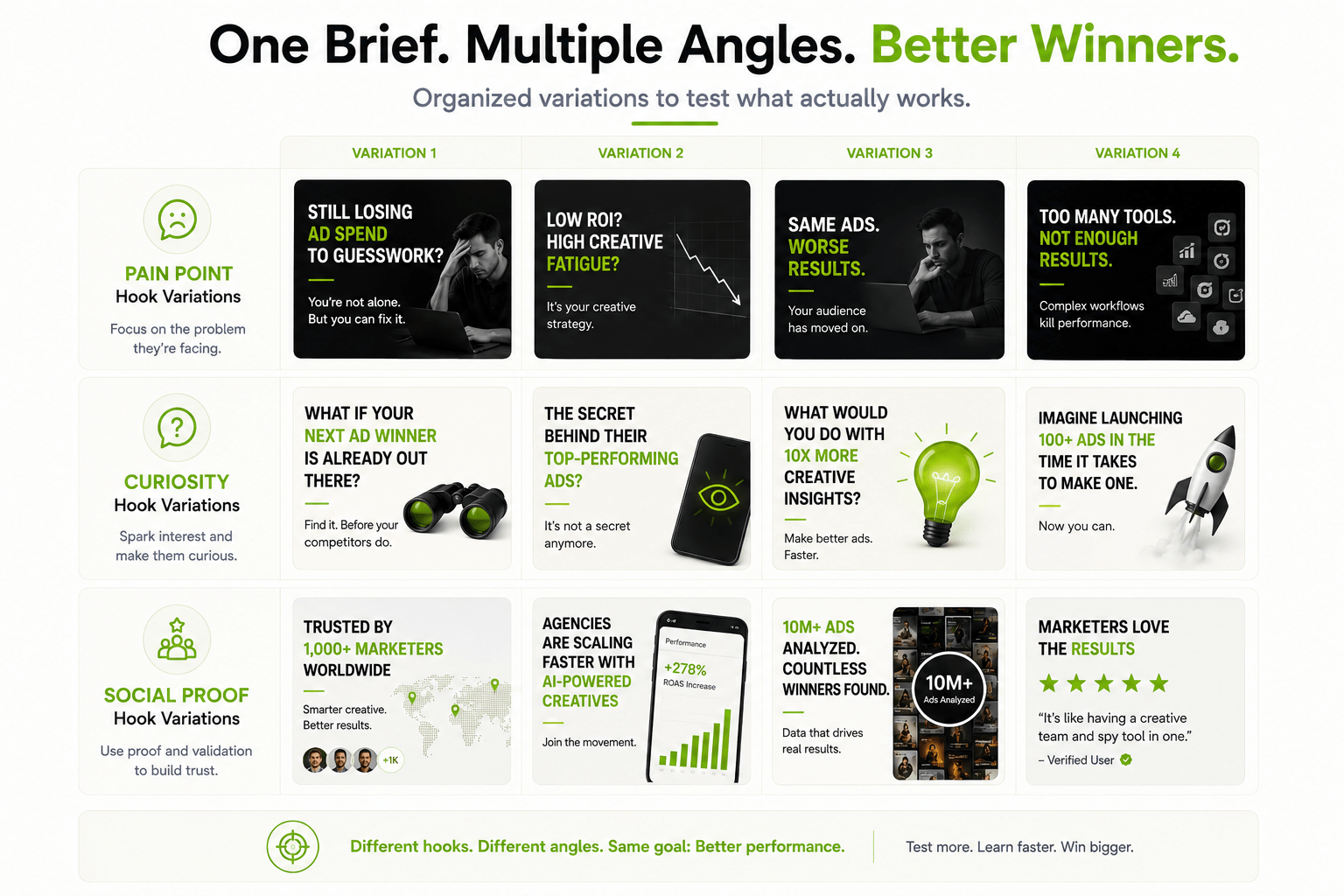
- The hook type you want to test – pain point, curiosity, bold claim, contrast, social proof
- The visual format – static image, UGC-style video, product showcase, carousel
- The platform and placement – TikTok feed, Meta feed, Stories, Reels
- The CTA – what action you want and how direct the ask is
Five minutes spent making the brief specific saves significant time in the review stage. A strong brief gets you 70-80% of the way to a usable ad before you’ve generated anything. Skip this step and you’ll generate ads with AI that miss the mark no matter how good the tool is.
Step 2: Generate Multiple Variations
With the brief built, run the generation. The goal at this stage is volume – you want multiple outputs per hook type and format so you have real options to evaluate. This is the stage where you generate ads with AI in volume rather than one at a time.
For a standard campaign launch, aim for 3-5 variations per hook type across 2-3 formats. That gives you 15-30 outputs from a single brief – a full variation set for a campaign launch.
Most AI ad generation tools – essentially an AI ad builder like FabFunnel’s Genie – let you configure format, hook direction, and visual style before generating, so you’re not sifting through random output. You’re reviewing a structured set of variations built around the hypotheses in your brief.
Step 3: Review and Select
Watch or review each output once against a simple set of criteria:
- Does the hook land in the first 2-3 seconds?
- Is the offer immediately clear?
- Does the visual feel native to the platform?
- Does the CTA match the intent of the creative?
Cut anything that doesn’t pass. You’re not looking for perfect – you’re looking for testable. A creative doesn’t need to be your best guess at a winner to be worth putting into a test. It needs to represent a genuine hypothesis.
Aim to select 8-15 variations from your generated set. That’s your launch batch.
Step 4: Launch and Structure the Test
How you structure the campaign determines whether you can read the results. This matters just as much for ai generated facebook ads as it does for TikTok, since Meta’s algorithm rewards a clear testing signal over scattered variations.
Group variations by what they’re testing. If you want to know which hook type works, put all hook variations in a single ad set so budget distributes across them naturally. If you want to compare formats, separate UGC from product showcase into different ad sets.
The structure depends on the question. Define the question before you set up the campaign, not after. That clarity matters most when you generate ads with AI at the volume this workflow produces.
Step 5: Analyze and Feed Back Into the Brief
This is the step most teams skip – and it’s where the workflow compounds.
After 3-5 days, you have performance data. Which hook type won? Which format had the lowest cost per result? Which CTA drove the best conversion rate?
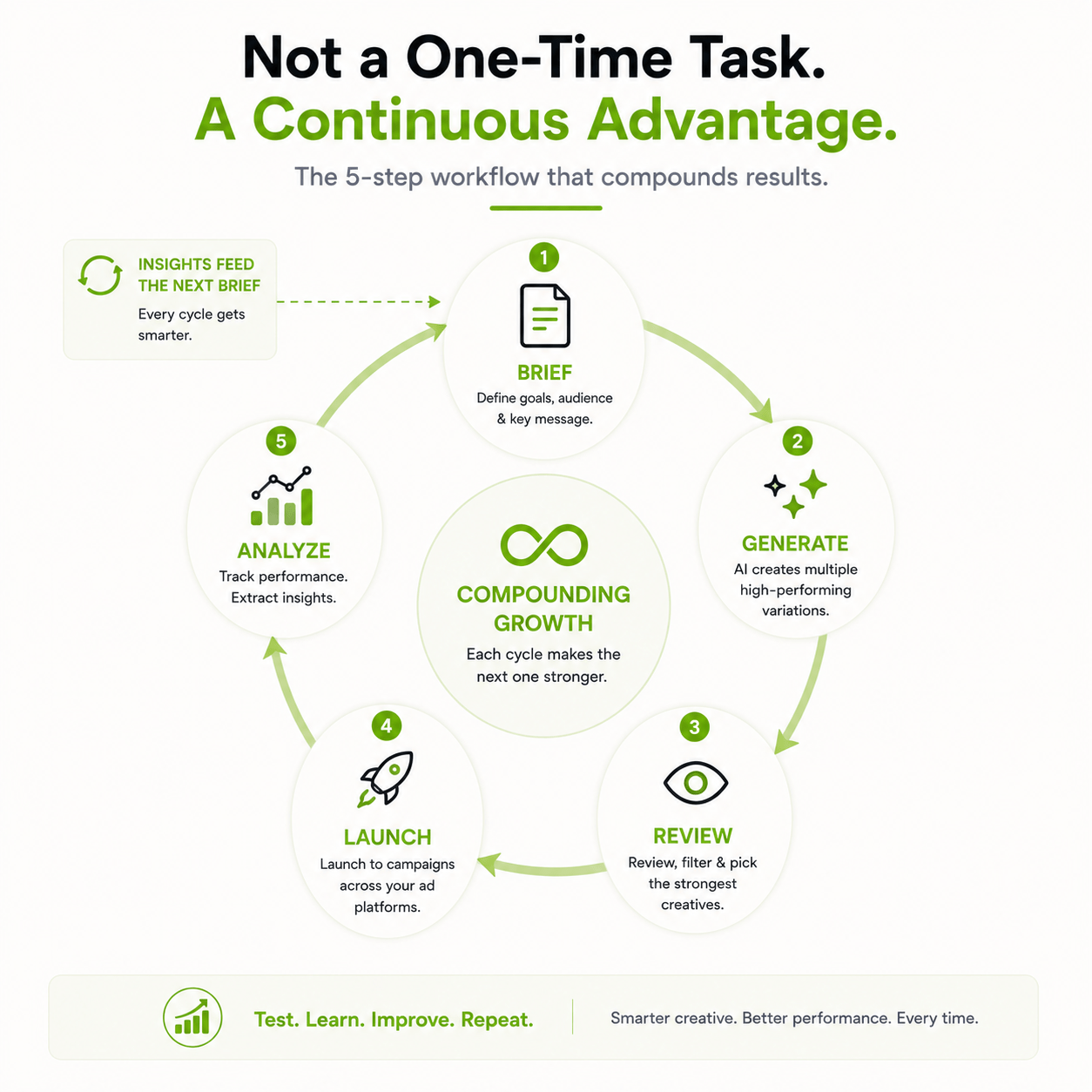
That analysis becomes the input for the next brief. You’re not starting from scratch each time – you’re building on what you learned. Over multiple cycles, this produces increasingly specific briefs and increasingly strong output. Each cycle makes it easier to generate ads with AI that perform better than the last batch.
What This Workflow Replaces – and What It Doesn’t
This workflow replaces the production layer of creative work: the design execution, the video editing, the format adaptation, the variation generation. Everything that happens after the creative direction is set and before the ad goes live. It’s the part of the process automated the moment you generate ads with AI.
It doesn’t replace creative strategy – deciding what angle to test, what the audience cares about, what makes an offer compelling. That judgment still sits with the marketer.
It doesn’t replace winning creative analysis – understanding why a specific creative outperformed requires human interpretation of data, not just AI generation of more content.
And it doesn’t replace the value of authentic creator content where brand fit matters. For performance-focused direct response campaigns, AI generation is the faster and more cost-efficient path. For brand campaigns where the creator’s identity is the asset, the calculus is different. Most performance teams still generate ads with AI as the default and reserve creator partnerships for brand campaigns.
The Takeaway: Generating Ads with AI Is Now a Core Operational Skill, Not a Shortcut
The teams treating AI ad generation as a shortcut are missing the point. The teams that have built it into their standard operating workflow – brief, generate, review, launch, analyze, repeat – are running learning cycles that manual production can’t match. They don’t just generate ads with AI once in a while; they’ve made it the default way work gets done.
The speed advantage compounds. Every cycle produces better briefs. Better briefs produce better output. Better output produces faster winners. And faster winners mean more of your budget goes toward what’s working, not toward discovering what doesn’t.
Generating ads with AI in 2026 isn’t a tool you use occasionally when you’re behind on creative. It’s the workflow.
Frequently Asked Questions
How do I start generating ads with AI if I’ve never done it before?
Start with a single campaign and one hook type. Build a specific brief – product, audience, hook angle, format, platform. Generate 10-15 variations, review them against the basic criteria (hook, clarity, platform fit, CTA), select 5-8, and launch. The first cycle is about learning the workflow. The brief quality improves from there.
What’s the biggest mistake people make when generating ads with AI?
A vague brief. Generic input produces generic output. Marketers who don’t spend time on the brief before generating end up with output they can’t use and conclude AI generation doesn’t work – when the actual problem was the input, not the tool.
How many ad variations should I generate before selecting my test batch?
Generate 2-3x what you plan to test. If you want to launch 15 variations, generate 30-40. This gives you culling room to discard weak outputs and select the best hypotheses without being forced to test everything you generated.
Can AI-generated ads work for B2B campaigns?
Yes, but the mix shifts. Static images and copy tests still carry B2B campaigns fine. UGC-style video is rarer here – it’s a consumer-feed format at heart – though it can work in direct response setups. What actually matters: the brief has to speak to a buyer weighing ROI and risk, not someone deciding whether to buy sneakers.
How long does the full workflow take?
Brief: 30-60 minutes for a thorough one. Generation: 1-2 hours for 30-40 variations depending on the tool. Review and selection: 30-60 minutes. Campaign setup: 30-60 minutes. Total: a morning. Compare that to a 2-3 week production cycle for the same creative volume. That’s the real time advantage of choosing to generate ads with AI instead.
Does AI ad generation work for video or just static images?
Both. Current AI video models produce UGC-style footage, product showcase video, and short-form content suitable for TikTok and Meta Reels. Static image generation is more mature and faster to produce. Most workflows use both – static for rapid testing, video for scaling proven angles.