AI marketing in 2026 – not what it used to be!
Remember when AI was just that thing you used to write ad copy or come up with quick campaign ideas? Yeah those days are over.
In 2026, AI is a legit growth engine for marketers. Helps u research audiences, create personalized ads, test different creative versions, figure out where to put your budget, and improve conversions. And it does all of this way faster than any person could.
Let’s be real about what works.
Customer data. Creative strategy. Predictive insights. Constant testing. That’s the combination.
Right message. Right person. Right time. That’s the goal.
Paid ads, email, social, full-funnel—AI helps you stop guessing and start executing with real data. It’s not magic. It’s just smarter.
In this blog, we will explore how to build AI marketing campaigns that actually convert in 2026. Campaign planning, audience research, ad creative generation, personalization, testing, real-time optimization. Plus practical steps so you can drive actual business results.
What Are AI Marketing Campaigns?
AI marketing campaigns are just regular marketing campaigns but you use artificial intelligence to help with the work. Planning, creating, launching, measuring, optimizing. All of it.
Now, a traditional campaign might take days or weeks just to do the research, writing, design, and testing. An AI-powered campaign speeds that up dramatically. You go from insight to execution so much faster.
AI marketing campaigns are exactly what they sound like marketing campaigns that use artificial intelligence to help with the work. Planning, creating, personalizing, automating, optimizing. All of it.
In simple terms? AI helps marketers make better decisions, and it helps them do it faster.
Think about it this way. AI can dig through huge amounts of customer data, spot patterns you’d never notice, generate content, recommend who to target, predict how campaigns will perform, and tweak your messaging based on what’s working right now.
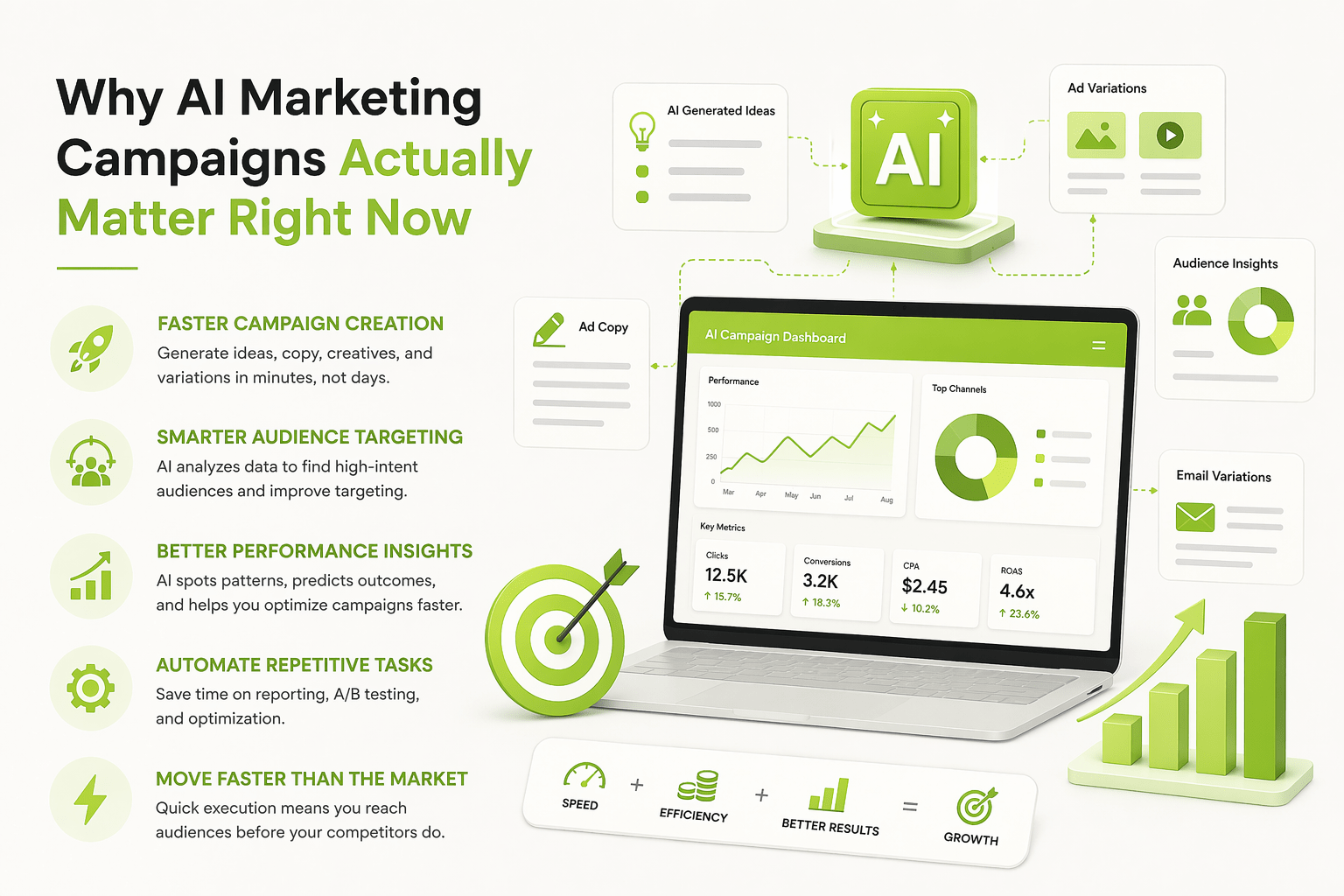
Why AI Marketing Campaigns Actually Matter Right Now
The digital marketing landscape is brutal. Ad costs keep climbing. People’s attention spans? Shorter than ever. And every brand out there is fighting for the same eyeballs across a dozen different channels.
Traditional marketing teams? They’re struggling to keep up. I see it all the time.
Creating audience segments, writing copy, designing creatives, testing variations, analyzing performance, it all takes forever when you’re doing it manually. And by the time you’ve finished, the market has already moved on.
This is exactly why AI marketing campaigns matter right now.
AI takes a huge chunk of that workload off your plate. It automates the repetitive stuff. It gives you faster insights. It helps you move at the speed the market demands.
One of the biggest wins I’ve seen? Speed.
A team can generate dozens of campaign ideas, ad creatives, headlines, email variations, and landing page concepts in a fraction of the time it would take manually. We’re talking hours instead of days. Sometimes minutes instead of hours.
In a world where being first often matters as much as being right, that’s a game-changer.
AI Marketing Campaigns vs Traditional Marketing Campaigns
Marketing in 2026 is brutal. Ad costs are up. Attention spans are down. Every brand is fighting for the same audience.
Traditional teams? Can’t keep up.
Segmentation, copywriting, design, testing, analysis—takes forever manually. By the time you’re done, the market’s moved on.
This is why AI matters. Right now.
AI takes the workload off. Automates boring stuff. Gives faster insights. Helps you move at market speed.
Biggest win? Speed.
A team can generate dozens of campaign ideas, creatives, headlines, email variations, landing pages—in a fraction of the time.
Manual: Days or weeks.
AI: Hours. Sometimes minutes.
When being first matters as much as being right? That changes everything.
How To Create High-Converting AI Marketing Campaigns
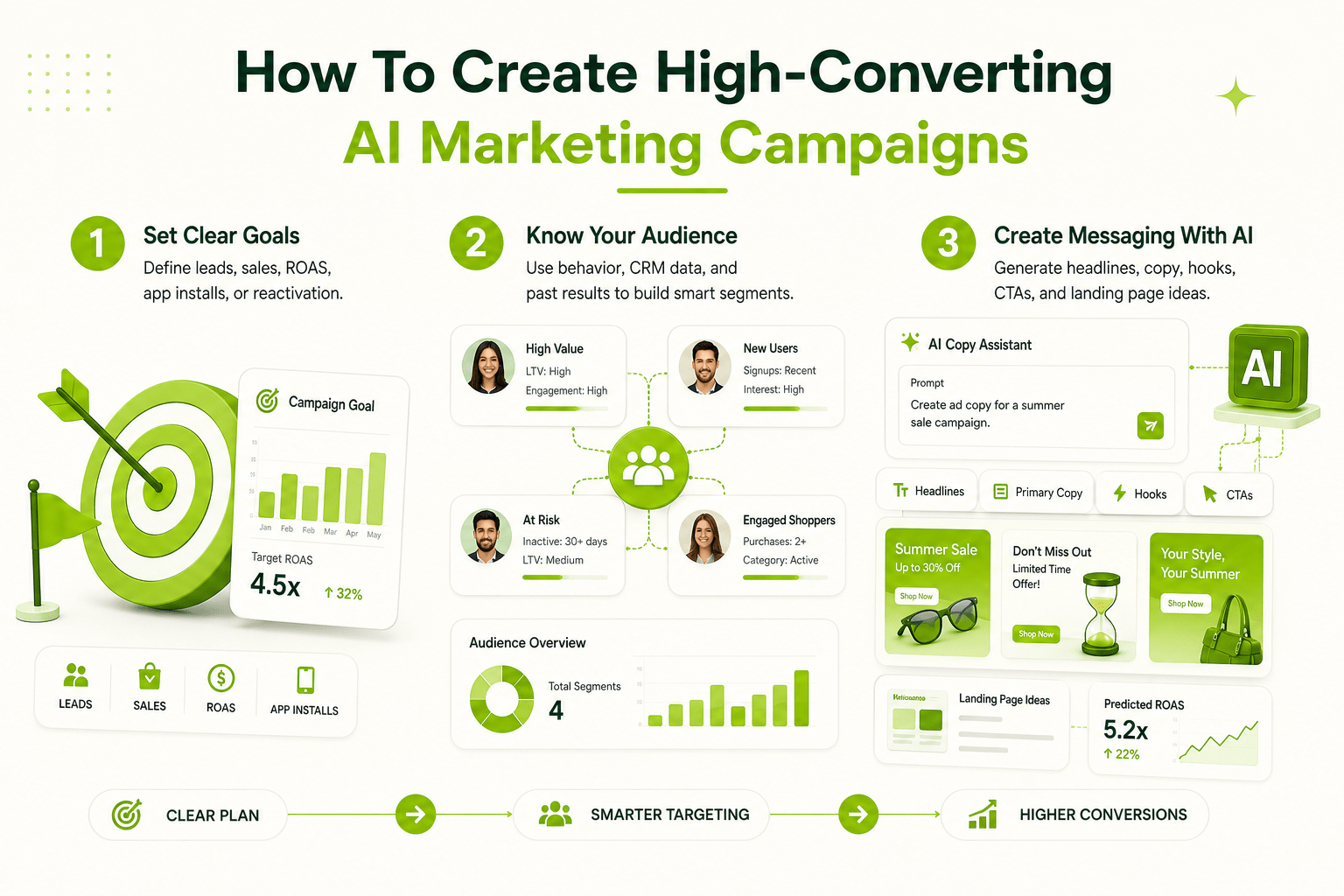
Step 1: Get clear on what you’re trying to achieve
Before you touch any AI tool, know your goal. Leads? Purchases? ROAS? App installs? Customer reactivation? The more specific you are, the better your AI tools will perform. Vague goals give you vague results.
Step 2: Know who you’re talking to
This is where AI actually shines. It can analyze customer behavior, purchase history, website activity, CRM data, and past campaign results to find patterns. Use that to build audience segments that make sense. Stop guessing with basic demographics.
Step 3: Create your messaging with AI
Now we’re in AI’s sweet spot. Headlines, ad copy, email content, landing page copy, hooks, CTAs, product descriptions—AI can generate all of it.
But here’s the key. The quality of your output depends on the quality of your input. Give AI detailed prompts. Brand. The more context you provide, the better the results.
Define Your Campaign Goal Clearly
Before you open any AI tool, before you write a single prompt, you need to know what you’re trying to accomplish. I’m serious about this.
AI is amazing, but it’s not a mind reader. It performs best when it has a clear target to aim for. If your goal is vague, your campaign will be vague. It’s that simple.
Some goals I’ve used that actually work:
- Generating qualified leads
- Increasing online purchases
- Improving return on ad spend
- Reducing cost per acquisition
- Driving app installs
- Increasing webinar registrations
- Retargeting abandoned cart users
- Re-engaging inactive customers
- Improving email conversion rates
Identify The Right Audience Using AI
Find your audience with AI. Quick take.
Goal set? Good. Now find your people.
Even the best message fails if it reaches the wrong audience. People who aren’t interested. Aren’t ready. Aren’t a good fit.
AI moves beyond basic targeting. Age, gender, location—that’s old. AI analyzes behavior, purchase history, website activity, CRM data, search intent, past campaigns. Finds high-value audiences.
Audience segments AI can actually help you build:
- High-intent buyers
- Returning customers
- Cart abandoners
- Lookalike audiences
- Churn-risk customers
- High lifetime value customers
- First-time website visitors
- Users ready for upsell or cross-sell
Conclusion
AI marketing campaigns are becoming one of the most effective ways for brands to plan, create, personalize, and optimize campaigns faster. And in 2026? U really cant afford to ignore them. Slow manual processes, generic messaging, limited testing—none of that works anymore. Customers always expect more and brands always do things differently to grab the customers.
But here’s the thing. High-converting AI campaigns still need human strategy.
AI can suggest audiences, write copy, create visuals, analyze performance. But you need to guide it. Clear goals, strong brand positioning, customer insights, ethical decisions—thats still on you.
AI is the engine. Ur the driver. Don’t forget that.
Also Read – Why Startups Should Use AI Generated Advertising In 2026
FAQs:
1. What are AI marketing campaigns?
Campaigns using AI to plan, create, personalize, automate, optimize. ad copy, targeting, email, testing, budgets, analysis.
2. How can AI improve marketing campaigns?
Analyze data, find audiences, generate variations, personalize, predict, optimize budgets. faster, less waste.
3. How do I create an AI marketing campaign?
Define goals, identify audiences, build personas, generate messaging, create creatives, test, track. strategy first.
4. What is an artificial intelligence advertising campaign?
paid ads with AI for creation, targeting, bidding, personalization, optimization. social ads, predictive search, dynamic display, retargeting.
5. Can AI create high-converting ad creatives?
Yes. generates concepts, headlines, hooks, CTAs, copy. but review, refine, test. AI starts. you finish.